
 Sonarworks SoundID Reference

Download Steinberg SpectraLayers Pro for macOS
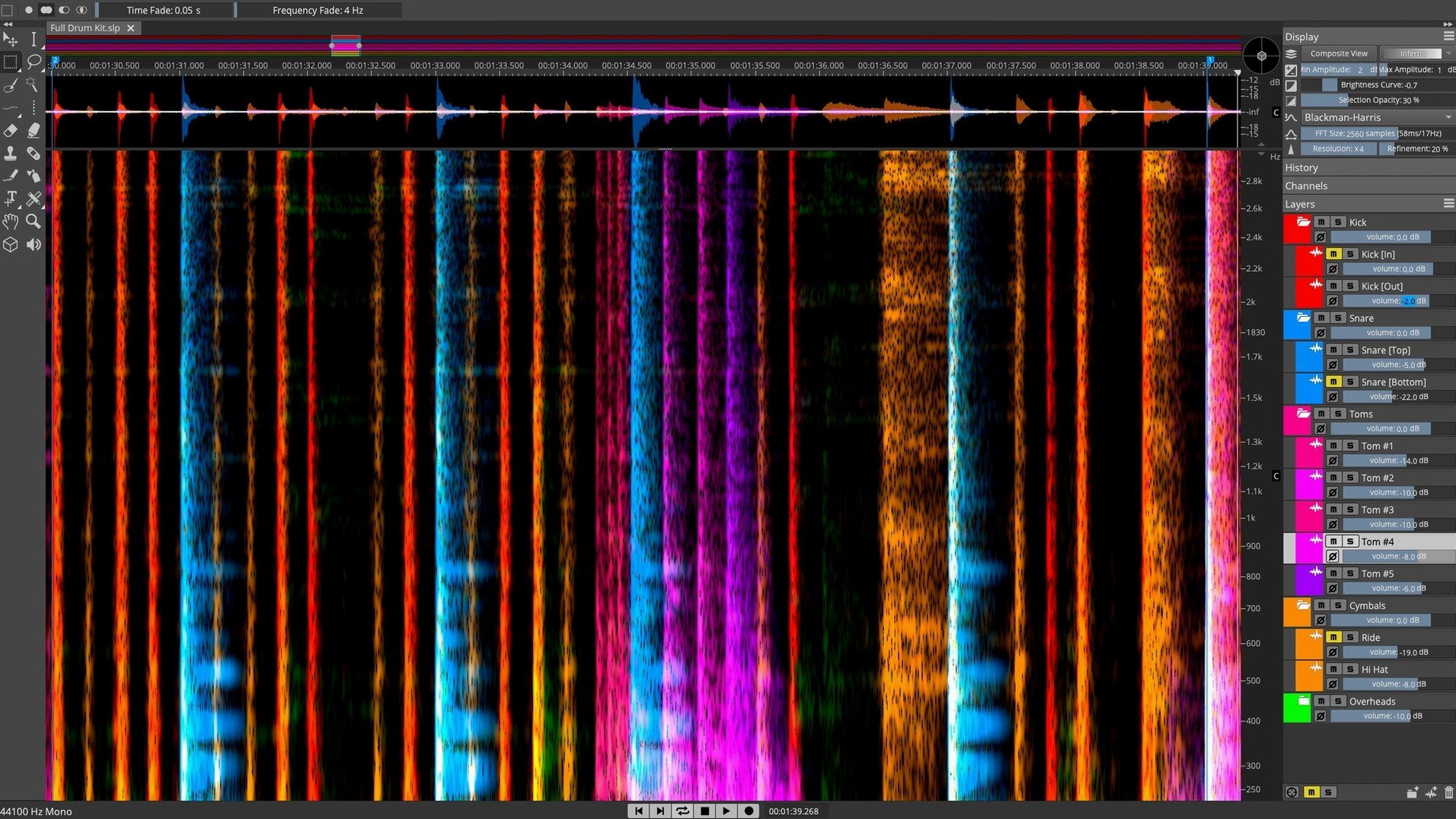
Each layer holds independent audio. Ten, twenty, more—edits stay non-destructive.
Unmix stems on a bus
Feed a stereo mix to the AI-based unmixing engine. Drums, vocals, bass and other instruments land on separate layers ready for rebalancing.
Repair a dialogue track
Open the Voice Denoiser to isolate human speech from background rumble. De-essing tools handle sibilance manually or automatically on the same layer.
Find and replace on a track
Select a squeak or click in the spectrum, then let Pattern Finder locate every similar event. Clean them all in one pass.
Fluid zoom and 3D on Apple silicon
On an M1 or M2 Mac with 16 GB of RAM, SpectraLayers Pro 13 feels fluent. GUI redraws keep up even when you zoom deep into a five-minute stereo file, and the 3D visualisation doesn't stutter after the initial render. We've run it alongside Cubase 13 via ARA 2 without a single beachball, even with six or seven layers active.
Big unmixing jobs—say, a four-minute dense rock track—ask the Neural Engine to work hard. You'll see the CPU spike for thirty to forty seconds while the AI separates drums, bass, vocals and "other" into layers. After that, playback and editing settle back to near-idle. Memory use sits around 1.2 to 1.8 GB for medium sessions; double that if you stack over a dozen high-res layers. On Apple Silicon the app is entirely native, and it shows.
One thing we noticed: the auto-save snapshot system writes generously but never blocks the UI. If your Mac has a fast internal SSD, you won't even feel it. Spinning hard drives add a small pause on save, so keep working files on solid-state storage when you can.
Workflow: rescue a voice memo recording
Imagine a field recording made on a phone—a spoken interview with traffic hum, a gust of wind across the mic, and a chair squeak halfway through. Here's how a typical cleanup runs inside SpectraLayers.
Drag the file onto the layer panel. The waveform and spectral display populate instantly. First step: hit Unmix Components and pick the Voice + Noise preset. In about twenty seconds the AI splits the recording into a voice layer and a background-noise layer. Mute the noise layer to check what's been stripped—usually tyre drone and room tone vanish cleanly.
Next, zoom into the spectral view where the chair squeak sits. It's a thin, bright vertical line. Lasso it with the freehand selection tool, right-click, and choose Remove Selection. The gap fills with surrounding ambience. If a second squeak hides elsewhere, run Pattern Finder on the first selection; it highlights the second one straight away.
Now tame the wind blast. Switch to the Amplitude tool, set a gentle negative gain, and paint across the low-frequency rumble in the spectrum. The voice layer stays untouched above 300 Hz. Finally, open De-ess on the voice layer, dial threshold to taste, and pull 3–4 dB off the sharp "s" sounds. Export a 24-bit WAV. Total time: under four minutes.
First-days setup tips
- Match the colour map to your eyes. Under View, try the "Cool" or "Fire" spectrum palette. Cool makes quiet harmonics easier to read on a bright display; Fire helps transients pop on a dimmed screen.
- Set your default selection mode. The freehand lasso is great for organic sounds, but switch to the time-frequency rectangle when you're cleaning hum at known frequencies—it's faster for surgical work.
- Keep layers named. After any unmix operation, double-click each layer and give it a real name: "Bass DI", "Vocal comp", "Room tone". The automatic "Layer 1, Layer 2" numbering gets confusing by session three.
- Leave snapshots on. SpectraLayers writes a snapshot every few minutes. It's saved more than one late-night edit from a mis-click. You can prune old snapshots from the History panel whenever the project folder gets chunky.
- Assign a hotkey to "Play Selected Layer Solo." In crowded sessions, this one shortcut does more for your workflow than half the tools. Set it once in Preferences and use it constantly.
Stem separation versus repair-only tools
iZotope RX 11 Advanced. RX is the repair-only king—it fixes clicks, hum, clipping and reverb tails with surgical modules. SpectraLayers overlaps on repair but pulls ahead when you want to rearrange audio. RX can't unmix a stereo track into stems or let you paint gain onto individual harmonics the way SpectraLayers does. The two apps complement each other; if repair is the main job, RX is quicker. If separation and creative layering matter, SpectraLayers wins.
Adobe Audition. Audition has a spectral frequency display and basic selection tools, but it doesn't offer AI-based unmixing, a dedicated Pattern Finder, or true multi-layer editing. Audition is a linear editor with spectral paint; SpectraLayers treats the spectrum as a fully editable canvas. For dialogue cleanup, Audition's adaptive noise reduction is simpler. For a mix that needs drums lifted out and rebalanced, SpectraLayers does in one step what Audition simply cannot.
Hit'n'Mix RipX DAW PRO. RipX is the closest conceptual rival: it also separates audio into layers and lets you edit notes and noise independently. RipX leans into MIDI-style note editing, making it great for fixing pitched material. SpectraLayers offers finer spectral control, deeper DAW integration through ARA 2, and a more mature de-noising toolset. If your world is Cubase or Nuendo, SpectraLayers fits more naturally; if you think in piano-roll terms, RipX may feel more familiar.
Good to know: people searching for spectralayers 12 mac torrent or spectralayers pro 12 torrent often land here looking for a fast way into spectral editing. The current version builds on everything that made version 12 great—faster unmixing, smoother ARA 2 handshake, and a cleaner UI.
Good to know: SpectraLayers integrates with your DAW and comes in Pro and Elements editions.
- macOS 12 or later
- Apple Silicon and Intel Macs
Questions I get
Yes, the AI-based track-to-stems unmixing separates drums, vocals, bass and other instruments onto individual layers.
The Voice Denoiser tool is built specifically to isolate human voice and reduce background interference.
Pattern Finder scans the spectrum for sound events that match your selection, so you can fix them all quickly.







Chat 0
Hop in or make an account to join the chat.
Quiet in here so far. If you have used this build, tell me what the install actually did.