
 Traktor Pro
 Transmit
 Trimma
 TunesKit iPhone Unlocker
 Tuxera NTFS
 Topaz Video AI
 Topaz Photo AI
 Topaz Gigapixel AI

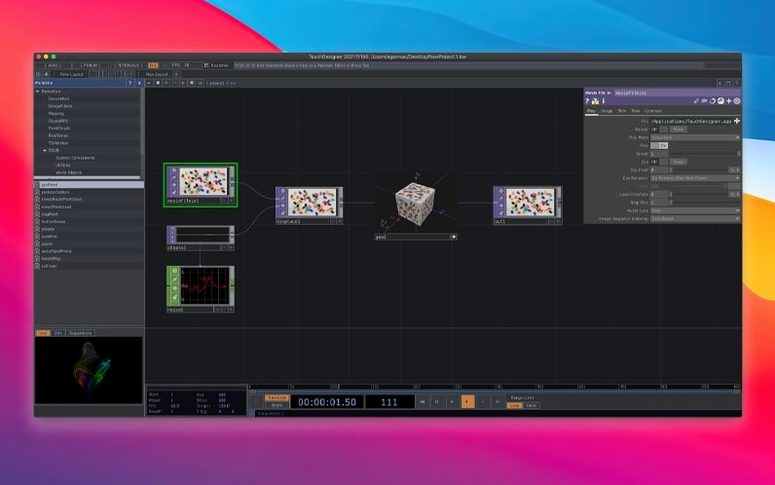
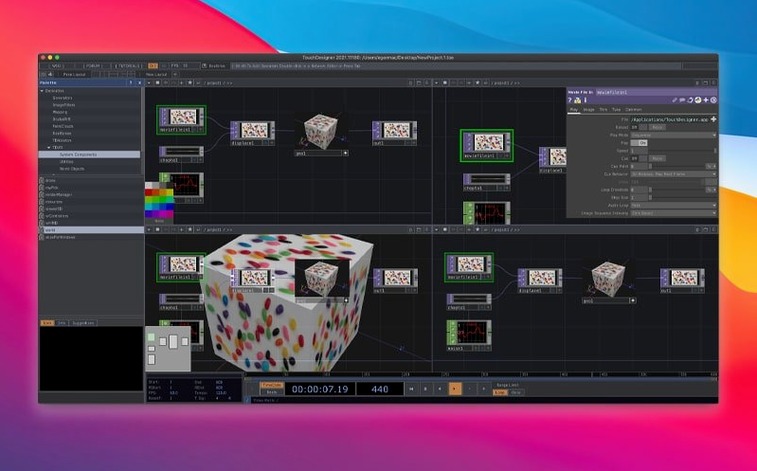
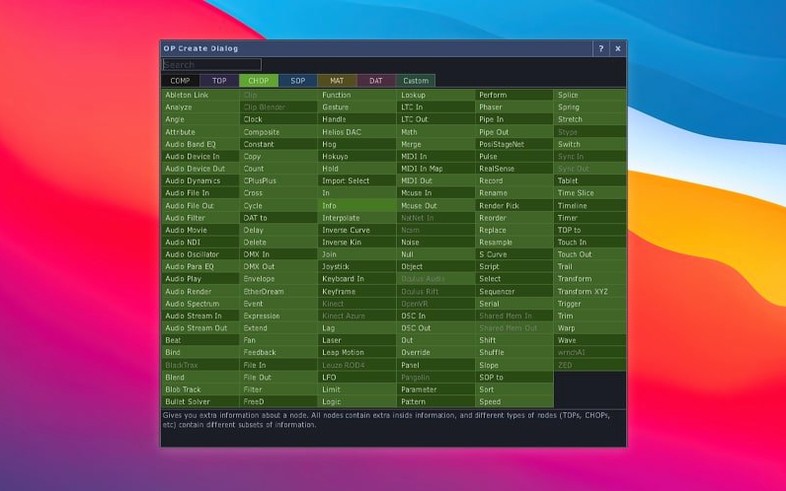
Point Operators — POPs for short — run entirely on the GPU and reshape 3D geometry on the fly. That kind of direct, real-time control is the heartbeat of TouchDesigner. It is a standalone visual programming environment, separate from the usual Mac app toolset, built for artists and designers who need interactive graphics to respond instantly.
TouchDesigner is a node-based platform where you connect operators to generate, process and output real-time media. Top Operators (TOPs) handle 2D textures and image streams, while POPs now bring GPU-powered point manipulation into the mix. Most TOPs also natively support 3D textures and 2D arrays, opening up richer layering and volumetric effects. The tool speaks to depth cameras and sensors too, with the Kinect Azure wrapper upgraded to 1.10.3 and the Orbbec SDK now on 1.10.16 with Intel Mac support added.
Projection mapping artists, live visual performers and installation designers live in this software. The built-in VR tools let you craft immersive scenes without leaving the workspace. It is the kind of environment where a theatre set, a gallery installation or a live concert visual all start as a handful of connected nodes. Toronto-based Derivative keeps the engine tuned for these demanding, real-world creative spaces.
You open a blank project and drop a Circle SOP onto the network. A ring appears in the viewer — flat, still. You wire a Noise CHOP into its radius parameter and the ring breathes. A few more nodes: a Geo COMP to hold everything, a Render TOP to flatten it into pixels. Within four minutes you have a pulsing shape that responds to your mouse position.
Now you add a Movie File In TOP pointed at a looping abstract clip. You connect it to a Displace TOP and feed the output back into the 3D scene as a texture. The ring starts warping to the grain of the video. This is the rhythm of a TouchDesigner session — small wiring decisions that cascade visually in real time, no compile step, no render queue.
You cluster related nodes into a Base COMP and give it a custom parameter panel. Later, when you reuse this cluster in another project, the panel travels with it. By the time you save and close, the network is a tidy graph of labelled containers, not a spaghetti tangle. Seasoned users call this “componentising,” and it is the difference between a sketch that only you can read and a system another artist can pick up.
Mara runs visuals for a small club. On a Friday she gets handed an hour of live music and no advance track list. She opens a project that reads incoming audio through a Audio Device In CHOP, splits the signal into frequency bands and maps the low end to a Circle SOP radius and the high end to a Transform TOP rotation on a live camera feed. The middle band drives the opacity of a noise layer.
Between sets she drops a new Movie File In TOP with a clip the band sent her ten minutes ago, wires it into the existing chain and adjusts the blend mode. The whole edit takes under a minute. The laptop running the show is an older Intel MacBook, the same one that has been doing this for two years. She never touches a timeline; everything reacts. By the last track she has added a Feedback TOP loop that trails the singer’s silhouette into coloured echoes, and the crowd is watching the screen as much as the stage.
The 2025 release cycle brought POPs onto the GPU. Before this, point-level operations meant round trips through the CPU or workarounds with TOPs. Now you can scatter, jitter and normalise millions of points directly on the card, keeping the frame rate high even when a Kinect Azure is feeding live depth data into the same scene. The upgrade to Orbbec SDK 1.10.16 and Kinect Azure 1.10.3 made those sensor streams more stable on Intel Macs, so the occasional mid-session disconnect that used to require a restart is far less common.
Most TOPs — image operators — now read 3D textures and 2D arrays natively. In practice that means you can stack volumetric slices inside a single node instead of chaining six 2D operators. A fog effect that once took a small subnetwork can live inside one GLSL TOP with a 3D texture input. The project file is lighter, the node graph is simpler and the GPU spends fewer cycles shuffling data between operators.
The viewer goes black after adding a new TOP. Nine times out of ten the node is not connected to a visible output. Check that its output wire eventually reaches a Null TOP or a Window COMP with its Display flag turned on. If the flag is on and the screen is still black, open the node's Common page and confirm the resolution is not set to zero.
Sensor feeds from an Orbbec or Kinect drop out randomly. The updated SDKs help, but the USB bus on some Intel Mac models can still get overloaded. Plug the depth camera into a different port, avoid sharing the same bus with an external drive and set the sensor resolution to a modest figure — 640×480 at 30 fps is enough for most interactive work.
POPs feel sluggish on a large point cloud. The GPU does the heavy lifting, but the node still needs to upload the data. If you are pushing over a million points, try a Point Transform POP instead of a chain of separate POPs; each additional node adds a pass. Also check that the Cook flag on heavy upstream nodes is not set to Always unless you genuinely need it recalculating every frame.
Keyboard shortcuts stop working after switching to a different app and back. This is a known macOS focus quirk on some Intel builds. Click once inside an empty area of the network editor pane, not the title bar, and the shortcuts return. If they do not, save your work and reopen the project — the state is briefly sticky but never permanent.














Chat 0
Hop in or make an account to join the chat.
Quiet in here so far. If you have used this build, tell me what the install actually did.