

Download Arturia Acid V for macOS
Runs on any Mac with macOS 11 or newer, Intel or Apple Silicon. The installer handles the architecture automatically, so you're set whether you're on an older Intel machine or an M-series laptop.
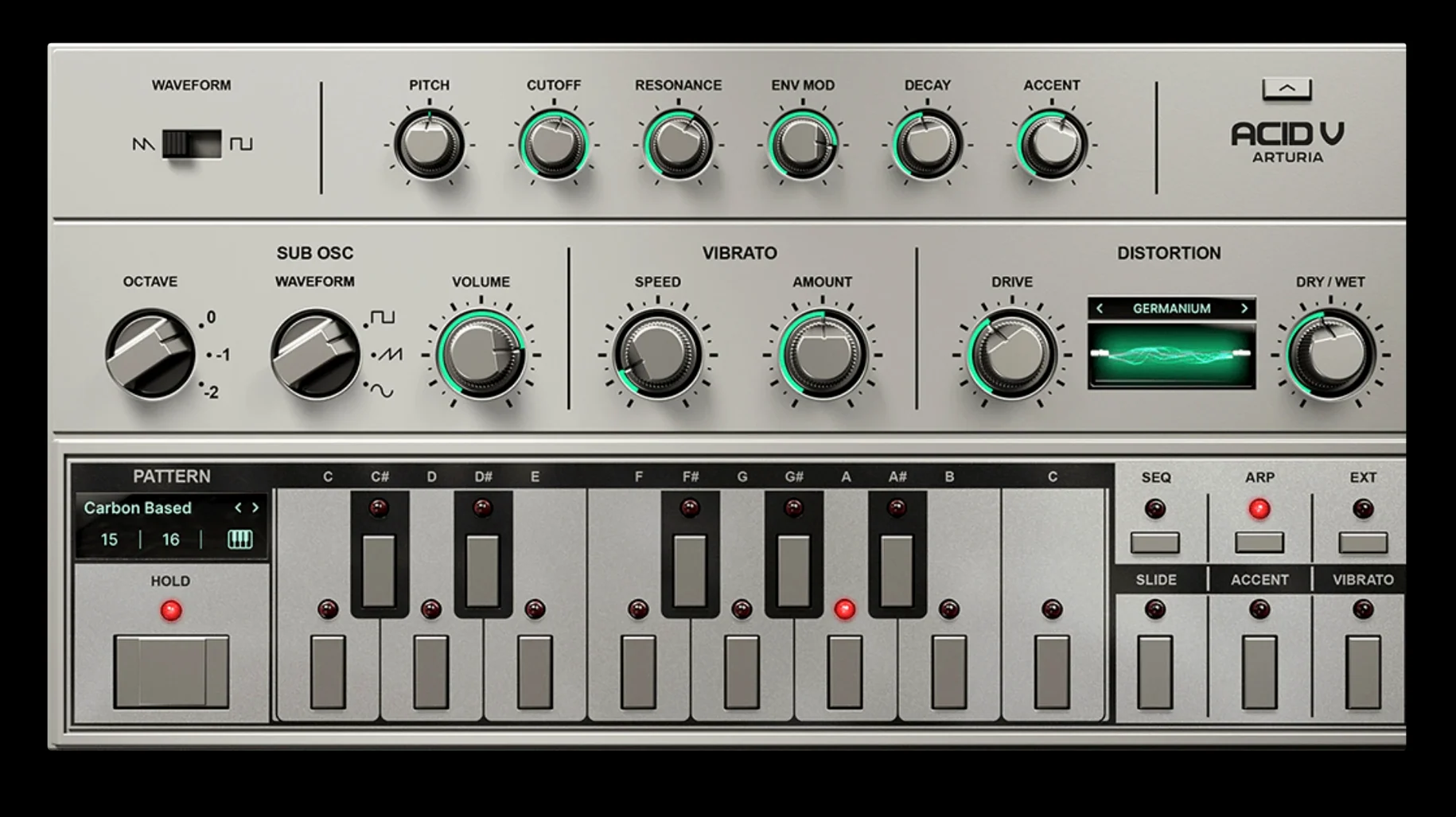
The oscillator block gives you square and triangle waveforms — the core shapes behind that hollow, rubbery 303 tone. Drive them through the filter and resonance controls and the sound shifts from a gentle throb into wet, tearing acid. Three multi-mode function generators sit off to the side, letting you bend pitch, chop the filter or warp the amplitude in patterns that drift away from the grid.
Arturia calls it a corrosive bassline synthesizer, and the sequencer is where that bite comes through. It's a polymetric affair with an arpeggiator that doesn't just step up and down — accents, slides and rests lock together in uneven bar lengths so the line feels alive and a little unhinged. Over 150 factory presets show off the range, from muted sub-bass murmurs to leads that sound like melting circuitry.
MTS-ESP microtuning support means you can pull the scale off equal temperament and explore tunings that give the acid formula a fresh, unfamiliar slant without touching a knob.
First days with Acid V
With over 150 presets, it's tempting to surf the library for an hour. Do that — then pick three favourites and study how they're built. Open the preset and look at the sequencer lane, the filter envelope and which distortion algorithm is active. Reverse-engineering a sound you like teaches you the signal flow faster than reading about it.
A few things worth doing early:
- Map your mod wheel to filter cutoff. Acid V's filter screams when you ride it in real time. Assigning the mod wheel gives you physical control over the squelch without touching the mouse.
- Try the sub-oscillator before you add distortion. Dial in a triangle sub two octaves down at about 30% mix. The weight it adds underneath a hollow square-wave pattern often means you need less drive later in the chain.
- Flip through the 14 distortion algorithms on a loop. Some clamp down hard and flatten the transient; others fizz at the top. Knowing which one does what saves you from cycling knobs blindly mid-session.
- Save a blank template. Strip a preset back to just the oscillator, sub and filter, then save it as your starting point. Future you will appreciate not starting from the default sawtooth patch every time.
If you grabbed the Arturia Acid V torrent pack floating around, double-check the installer includes the preset bank — missing sound libraries are the usual culprit when patches don't load.
Building an evolving acid line from scratch
Here's a workflow for a track that needs a bassline that shifts over eight bars rather than looping the same two-bar phrase.
- Start with the sequencer. Clear the default pattern. Program a 12-step sequence — odd lengths keep it off-balance. Place accents on steps 1, 4, 7 and 10, then add a slide between steps 10 and 11. Set the arpeggiator to a 7-step cycle so the accent pattern and arp cycle drift against each other.
- Shape the oscillator. Keep the waveform on square but back the pulse width off slightly — not full hollow, just a little pinched. Bring the sub-oscillator in at -1 octave, sine shape, mixed around 25%. It fills the low end without muddying the filter sweeps.
- Set the filter envelope. Moderate resonance with a decay that drops off over about 40% of the step length. You want the "wow" sound on the accents without the tail choking the next note.
- Assign a function generator to filter cutoff. Choose the slowest shape, something like a rising ramp that takes two bars to climb and one bar to fall. Dial the modulation depth so the filter opens by maybe 15–20% at its peak. Now the tone breathes over the length of the phrase instead of repeating mechanically.
- Add distortion late. Start with the "Germanium" algorithm at low drive. Dial the mix back to 50% wet. Acid V's distortion can swallow a mix quickly, so blend rather than replace. Crank the drive only for a bridge or drop section.
- Stack two FX. Slot one: a short stereo delay with the left and right times offset by a few milliseconds for width. Slot two: a touch of reverb with the low end rolled off so the sub stays tight. Keep both subtle — this is a bassline, not a pad.
Once the pattern runs, grab the shift control and nudge the sequence start point while the DAW plays. Moving the downbeat by a step or two changes the groove entirely without rewriting a single note.
- macOS 11 or later
- Intel or Apple Silicon Mac
Questions I get
Yes, it includes MTS-ESP microtuning support so you can load custom scales directly into the synth.
The analog oscillator delivers square and triangle waveforms, matching the voice of the original TB-303 hardware.







Chat 0
Hop in or make an account to join the chat.
Quiet in here so far. If you have used this build, tell me what the install actually did.