


Download Plugin Alliance Shadow Hills OptoMax for macOS
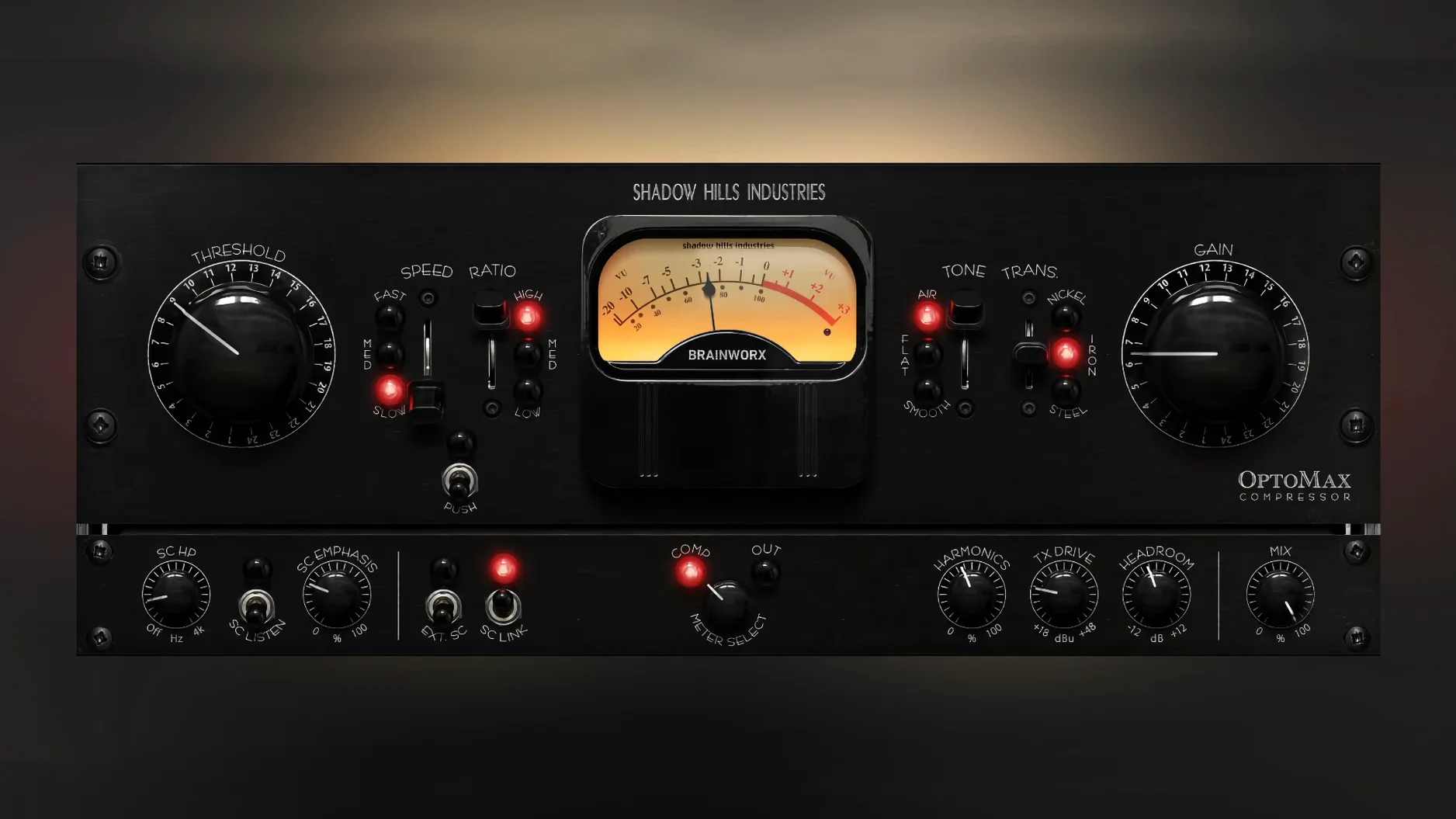
Version 1.0.0 lands as Brainworx's take on the optical heart of a mastering icon, stripped into a single plug-in. It's a leveller that thinks in light rather than voltage, grabbing transients with a slower, more musical hand than a VCA. The controls push you toward a handful of distinct sounds.
- Slow, medium, fast response — not just attack times, but three distinct ways the optical cell tracks the signal.
- Softness — a high‑frequency control that lets the top end breathe around the compression.
- Three transformers — Nickel stays clean, Iron adds weight, Steel brings a bit of bite and saturation.
- Parallel mix — blends the dry signal back in so dynamics stay natural while levels even out.
- Advanced sidechain filtering — tells the detector to ignore low-end rumble or focus on a specific band.
It's a single-minded tool. You pick a transformer, set a response, and let the optical cell do what it does best: smooth over a track without flattening it. The parallel knob alone makes it worth reaching for on a drum bus or a vocal that needs to sit still without sounding pinned down.
Vocals and bass that wander in level
If you mix vocals that wander in level or bass parts that poke out on certain notes, the OptoMax slots in like it was already there. Singers who lean into a chorus get tamed without the tell‑tale grab of a fast VCA. Bassists who dig in with a pick hear the low end stay solid while the transient rounds off just enough.
Mixing engineers who build chains around a single flavour tend to reach for it early. The three transformer options mean one plugin can shift from a clean, open master-bus leveller to a thicker, slightly hazy channel compressor without swapping tools. Mastering engineers who already know the hardware will recognise the Nickel setting as a quick way to add glue without changing the tone.
It also suits anyone who hates overthinking attack and release. You're choosing a behaviour, not dialling milliseconds. That alone makes it quick to trust on a deadline.
Nickel vs iron vs steel transformer choice
The defaults sound polished, but a few tweaks reveal what the plugin actually wants to do.
- Transformer first. Nickel is the honest starting point. Iron thickens the low‑mids nicely on a drum room or a bass group. Steel pushes the high‑mids forward—great on a strummed acoustic that's getting lost.
- Response second. Fast mode on a snare close mic can choke the body if you're not careful. Switch to medium and you keep the crack while the ring settles. Slow works beautifully on a full mix where you just want the loudest moments to dip by a dB or two.
- Parallel mix early. Don't save it for the end. Pull the dry signal up to about 40% while driving the input harder than feels sensible. The compressed side does the heavy lifting, the dry side keeps the attack, and nothing sounds squashed.
- Softness on bright sources. A sibilant vocal or a splashy overhead can feel brittle when compressed. Push Softness to around 6 and the highs relax without dulling the track.
Pre‑install CPU and iLok concerns
Is this the full Shadow Hills Mastering Compressor in one plugin?
No. The OptoMax focuses solely on the optical section. You don't get the discrete or VCA stages. What you do get is that particular slow‑hand levelling with the transformer colour from the original, packaged so it loads fast and slots into any insert without the full rack's complexity.
Will it run natively on Apple Silicon?
Yes. The plugin runs on both Intel and ARM Macs, so an M1 or M2 machine won't push it through Rosetta. It showed up in our AU and VST3 folders without extra steps.
Can it do the heavy limiting some optical compressors are known for?
It leans more toward smoothing than brick‑wall control. On the fast response setting with Steel engaged you can push it into obvious gain reduction, but the character stays round rather than aggressive. It's not a replacement for a dedicated limiter.
Does the sidechain filter work well for ducking a bass against a kick?
It can, though that's not its main job. Set the sidechain to filter out lows below 80 Hz and the optical cell reacts more to the kick's beater click than the body. On a bass group that needs to dip just a touch, it's more transparent than a broadband compressor with a key input.
- Initial release on Mac.
- macOS 12 or later
- Apple Silicon or Intel Mac
Questions I get
It's inspired by the optical compression section from the Shadow Hills Mastering Compressor.







Chat 0
Hop in or make an account to join the chat.
Quiet in here so far. If you have used this build, tell me what the install actually did.